Weight Loss Tracker Spreadsheet: Track the Trend, Inches and Workouts in One File
Weight loss tracker spreadsheet: the 7 fields it needs, the 7-day average formula, and a 14-day worked example, for Google Sheets and Excel.
By Ultimate Fitness Tracker by Cosmo Suite · Editorial policy
Published · 7 min read
A weight loss tracker spreadsheet is a file that logs your weigh-ins by date and works out the trend for you. It works when it shows the trend, not just the number: dated weigh-ins, a 7-day average beside each one, and room for measurements, photos and workouts. Weight alone gives you a jumpy line and no way to read it.
Many people who go looking for one have already tried a calorie app or a paper journal. The app kept the history behind a paywall, or the journal couldn't do the math. A sheet does the math, and the file stays yours.
Here's what the sheet needs, the one formula that calms the scale, and a worked example in both Google Sheets and Excel. Ultimate Fitness Tracker is the weight loss and workout spreadsheet we make, and it's covered near the end.
The Trend Line (key takeaways):
- A single weigh-in is noisy. The 7-day average is the number to read.
- Seven fields turn a weight list into a tracker: date, weight, 7-day average, change since last, change since start, measurements, notes.
- Inches, photos and lifts often move when the scale doesn't, so log them in the same file.
- The method is free. You can build it in ten minutes or start from a finished file.
What the Numbers Say
Each number in a tracker needs a job. The table shows what to record, what it tells you and how often to check it.
| Number | What it tells you | How often to check |
|---|---|---|
| Daily weigh-in | One reading, affected by water, food and timing | Log it; don't judge it |
| 7-day average | The direction your weight is actually moving | Once a week |
| Change since start | How far you've come over the whole run | Once a week |
| Body measurements | Whether inches move when the scale doesn't | Every 2 to 4 weeks |
| Progress photos | Changes a tape measure can miss | Every 2 to 4 weeks |
| Workout log | Whether strength and effort are building | After each session |
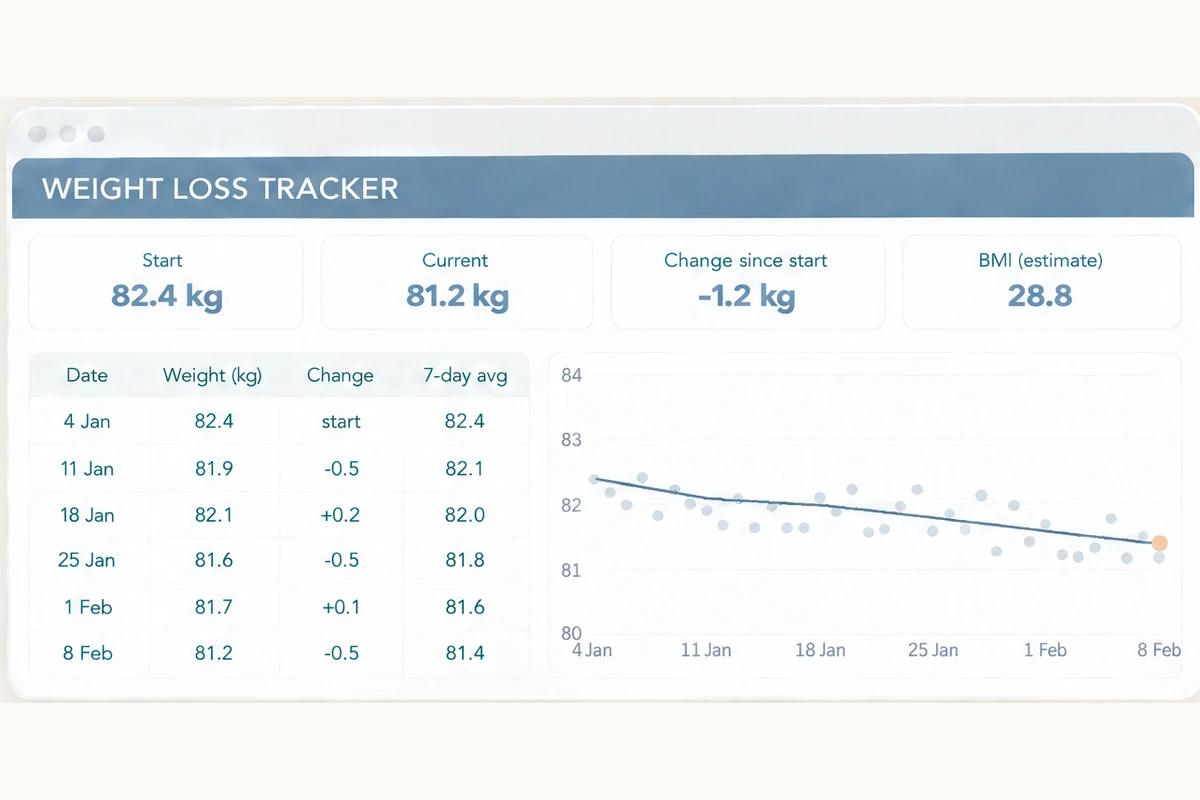
[Unique insight] The point of the table is the first row. A daily number is data, not a verdict. The Cleveland Clinic puts the normal window for people in a healthy weight range at about 5 to 6 pounds, or 2 to 3 pounds in either direction (Cleveland Clinic, Weight Fluctuation). A sheet that only lists those readings makes every bounce look like news.
What a Weight Loss Tracker Spreadsheet Needs
Seven fields do most of the work. Anything else is a bonus.
- Date. One row per weigh-in, dated, so a missed week is just a gap and not a reset.
- Weight. In the unit you use. If you're in the UK, a stone and pounds column saves mental math.
- 7-day average. The formula is below.
- Change since last weigh-in. Current weight minus the previous row.
- Change since start. Current weight minus your first entry.
- Measurements. Waist, hips and the other sites you care about, on their own tab.
- A notes cell. Sleep, travel, a hard session. Short, and only when it explains something, such as a late night or a trip.
The CDC's advice on getting started is to write things down: nutrition, activity and sleep, in a log or an app (CDC, Losing Weight). The Cleveland Clinic says something similar: writing weight down helps you follow trends over time, and makes course corrections easier when it's consistently up for days or weeks. Both are arguments for keeping the record somewhere you can read it back.
If you'd rather not build it, a weight loss tracker spreadsheet that keeps the 7-day average beside every weigh-in has these fields already linked.
The 7-Day Average, Worked Example
The 7-day average is the mean of your last seven weigh-ins. In a spreadsheet it's one formula, and it works the same in Google Sheets and Excel: =AVERAGE(B2:B8) on the seventh row, filled down. For example, both Google and Microsoft document AVERAGE the same way: it ignores text, and Excel skips empty cells too, so a blank day doesn't break it.
[Original data] Here are 14 days of example data (invented for this post, in pounds, not a typical or expected result):
| Day | Weigh-in (lb) | 7-day average (lb) |
|---|---|---|
| 1 | 182.4 | n/a |
| 2 | 183.8 | n/a |
| 3 | 181.9 | n/a |
| 4 | 182.6 | n/a |
| 5 | 183.5 | n/a |
| 6 | 181.7 | n/a |
| 7 | 182.2 | 182.6 |
| 8 | 181.8 | 182.5 |
| 9 | 183.1 | 182.4 |
| 10 | 181.2 | 182.3 |
| 11 | 181.9 | 182.2 |
| 12 | 182.8 | 182.1 |
| 13 | 180.9 | 182.0 |
| 14 | 181.4 | 181.9 |
The daily column swings by 2.9 lb between its highest and lowest reading (183.8 and 180.9). The average column drops 0.7 lb over the same week and never goes up. Looking at day 9, the reading is 183.1, a 1.3 lb jump from the day before, and the average still goes down by 0.1.
Why wait seven days for the first average?
The formula needs seven entries before it has a full week to average. Some people start with a shorter average for the first days; the cleaner option is to leave those cells blank so the number means the same thing every row.
What if I miss a day?
Log the next weigh-in on its own dated row and leave the gap. The formula averages whatever is in the range, so a missed day doesn't reset anything. It just means the row count isn't exactly seven days, and that's fine for tracking.
Which unit should I use?
The one you think in. Pick it once at the start and stay with it, so the average isn't mixing units. Lifting weights can use a different unit from body weight.
Beyond the Scale: Inches, Photos and Workouts
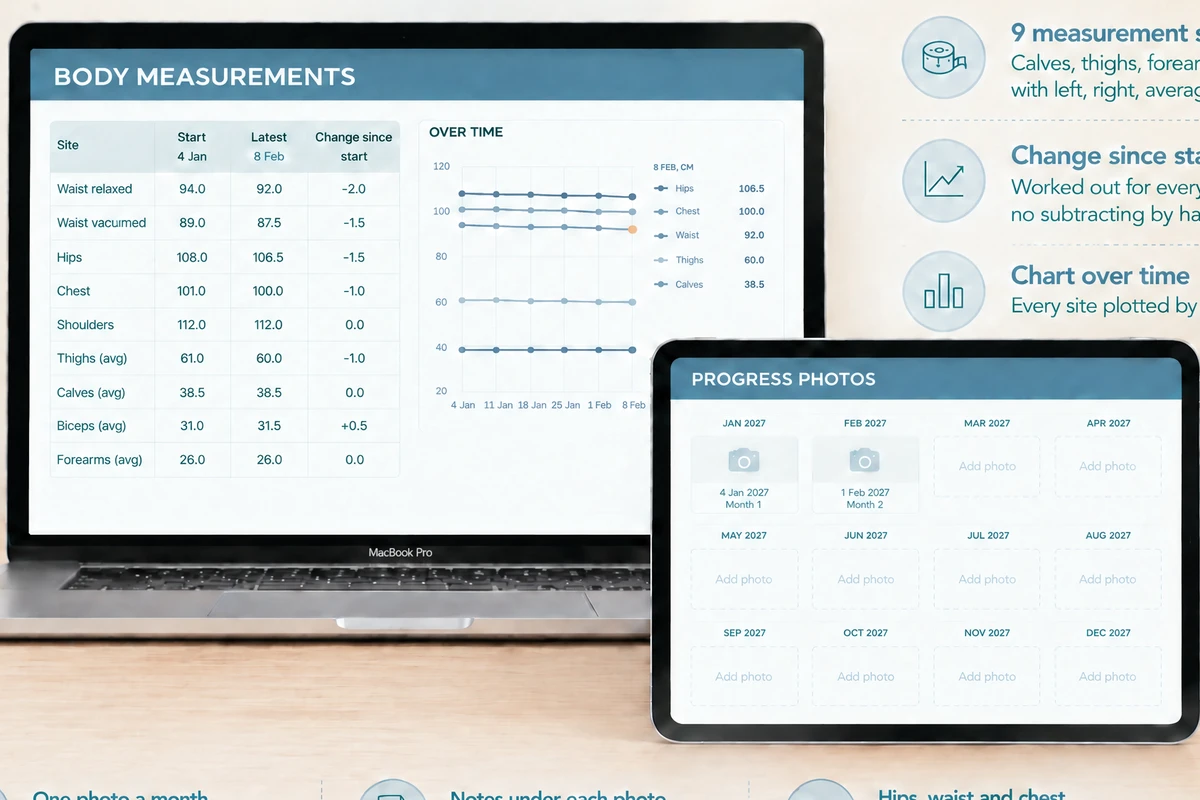
Change since start is the current weight minus your first entry, and it is only one measurement of several. When the waist measurement drops and the weight stays flat, a weight-only sheet shows nothing, and it's easy to decide the effort isn't working. A tracker that holds more has a better chance of showing the change.
- Measurements: measure the same sites at the same point each time, every 2 to 4 weeks, and record change since start.
- Progress photos are dated pictures taken the same way each time: same light, distance and time of day. Twelve dated slots cover a long run.
- Workouts: sets, reps and weight, with what you lifted last time next to each exercise, so you know what to beat.
- Calories (optional): if you track them, treat the totals as an estimate, not a target the sheet sets for you.
This is about tracking, not medical advice. Talk to a doctor about your own health. None of this tells you what to eat or how much to lose, and a good tracker shouldn't try.
A single file that holds weigh-ins, measurements and workouts together lets you look at all three when the scale stalls.
Build One or Start From One
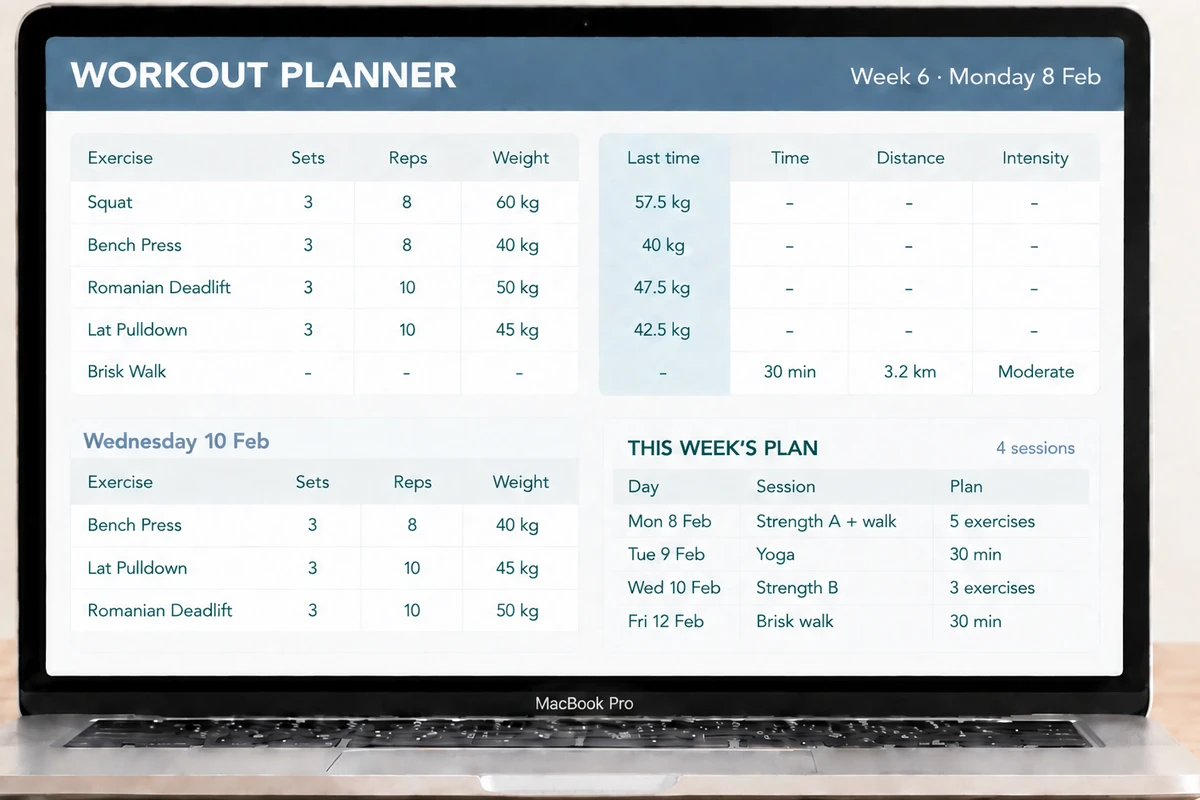
You can build a basic tracker in about ten minutes: a date column, a weight column, the AVERAGE formula and a change-since-start column. That's enough to try the method, and it costs nothing.
Homemade sheets tend to break later: formulas copied wrong across rows, units that don't convert, charts that stop updating, and no tab for measurements or lifts. Add all of that and you've built a small app, which is where a finished file starts to save time.
Free sheets on blogs are usually weight-only. Template listings on marketplaces vary a lot in what they include, so check that the one you pick lists the 7-day average, measurements and both Google Sheets and Excel, and that you can see the tabs before you buy.
Why Trust This Article
We're the Cosmo Suite team that builds the Ultimate Fitness Tracker spreadsheet, so we have a stake in the answer, and we've kept the method free in this post. The medical figures come from the Cleveland Clinic and the CDC, linked above and checked on 5 October 2026. The 14-day table is example data we invented to show the formula; it isn't from a user. You can read about us and the company behind this site and our editorial policy, or reach us through the contact page. Verify any figure before you act on it. This is about tracking, not medical advice. Talk to a doctor about your health.
Where the Ultimate Fitness Tracker Fits
Weight-only tracking has one weakness: the scale is the only thing it can answer. When the number stalls or jumps, there's nothing else to look at.
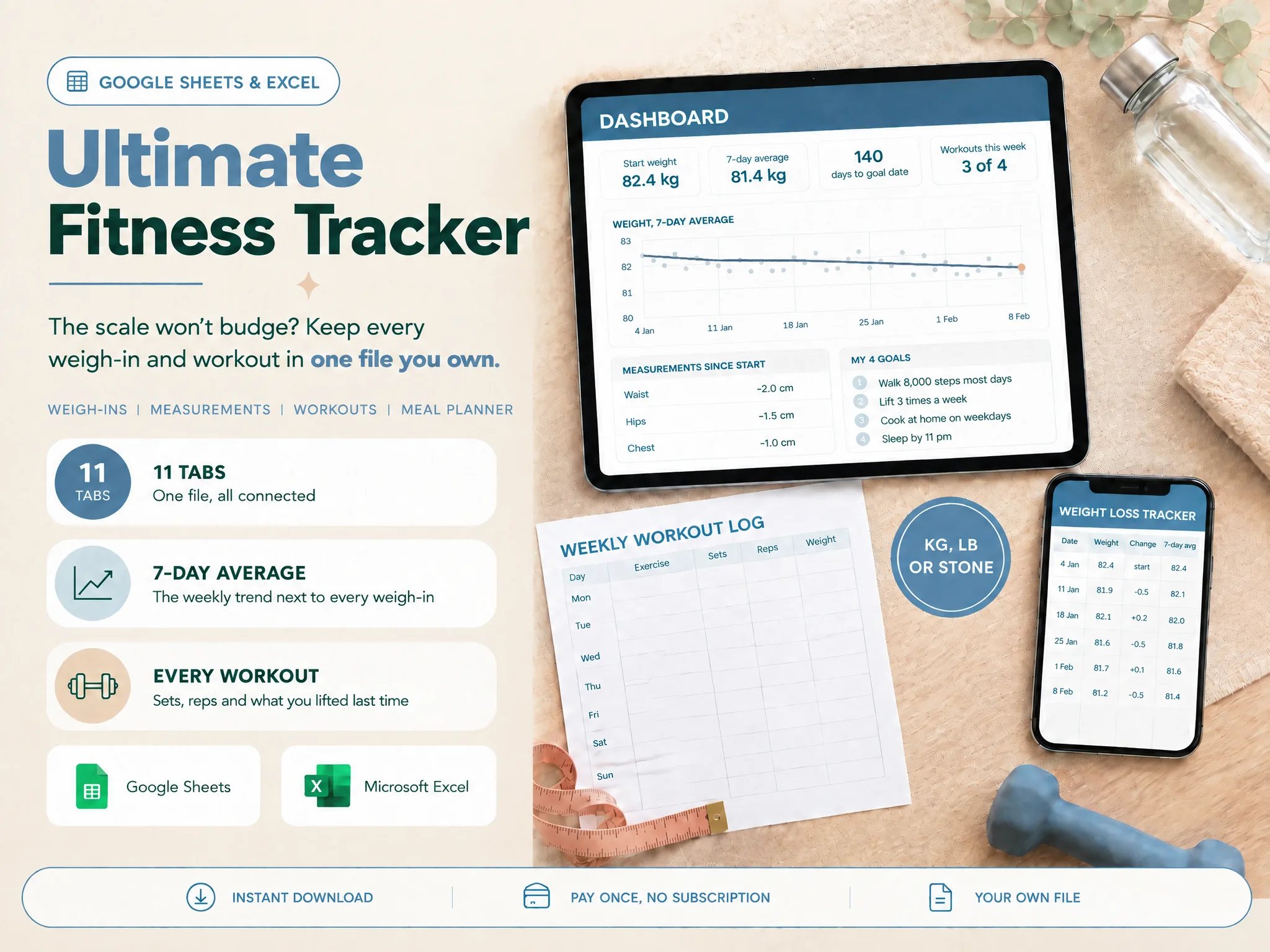
Ultimate Fitness Tracker is a weight loss and workout spreadsheet (ultimatefitnesstracker.site) with 11 connected tabs in Google Sheets and Excel, both included. Every weigh-in gets a 7-day average beside it, with change since the last weigh-in and since the start, and a weekly trend line. Body weight can be kg, lb or stone and lb, and the charts convert.
It also holds the rest of the file: nine measurement sites with change since start, 12 dated progress-photo slots, and a workout log that shows what you lifted last time next to each exercise. A calorie tracker tab is optional, and BMI and BMR are shown as estimates. There are three printable pages as well: a weekly workout log, a monthly weigh-in and measurements page, and a goal and milestones page.
It doesn't scan barcodes, hold a food database or sync with scales or devices; that's what apps do. It's your own file, bought once at $9, with no ads and no account with us. See the weight loss tracker spreadsheet and its tabs.
Frequently asked questions
What should a weight loss tracker spreadsheet include?
Dated rows for weigh-ins, a 7-day average beside each one, change since your last weigh-in and since the start, body measurements, progress photos and a workout log. Calories are optional. If a sheet only holds weight, it can't tell you much when the scale stalls.
Is a spreadsheet better than a weight loss app?
It depends on what you need. Apps win on barcode scanning and food databases. A spreadsheet wins on owning your history, seeing the trend however you like and paying once. If you only want weight, measurements and workouts, a sheet is enough.
Should I weigh myself every day?
Many people do, and the daily numbers are fine to log as long as you read the 7-day average instead of any single day. If daily weigh-ins stress you out, weigh on a fixed weekday and keep the rest of the file going. This is about tracking, not medical advice.
Can I use the same spreadsheet in Google Sheets and Excel?
Yes, if the formulas are plain ones such as AVERAGE. Both programs read it the same way. Check that your units and date format match your region before you start, since a stone and pound entry needs its own column.
How do I get the 7-day average in a spreadsheet?
On the seventh weigh-in, type =AVERAGE of the last seven weight cells, for example =AVERAGE(B2:B8), then fill it down. Each new row averages the seven most recent entries. If you skip a day, the formula still runs, but the row count no longer equals seven days.
Do I have to track calories?
No. Plenty of people only log weight, measurements and workouts. Add calories later if you want them, and treat any calorie or BMR figure in a sheet as an estimate for your own records.