Rate of Perceived Exertion: How to Add a 1-10 Effort Column to Your Lifting Log
rate of perceived exertion: understand the lifting scale, separate it from Borg scores, and record effort beside sets, reps and weight in your workout log.
By Ultimate Fitness Tracker by Cosmo Suite · Editorial policy
Published · 7 min read
General information, not medical or fitness advice. Talk to a qualified professional.
Rate of perceived exertion (RPE) is a record of how hard an activity feels. For lifting, a repetitions-in-reserve scale gives that effort a 1-10 rating. Its upper end describes how many more repetitions you estimate you could have completed. It is a subjective record, not a measurement from a device.
You can finish two sessions with the same weight and reps but remember them differently. A log that holds only the load loses that distinction. Adding an effort field lets you retain it without replacing the numbers you already record.
This guide explains which scale you are using, what to put in the column, and how to read a labelled example. It gives no target effort or training plan.
The Trend Line (key takeaways):
- Name the scale before entering scores.
- Keep an effort rating beside the exercise, weight and reps it describes.
- State whether the score describes one set, the last set, or a whole session.
- Leave missing scores blank rather than reconstructing them later.
What the Numbers Say
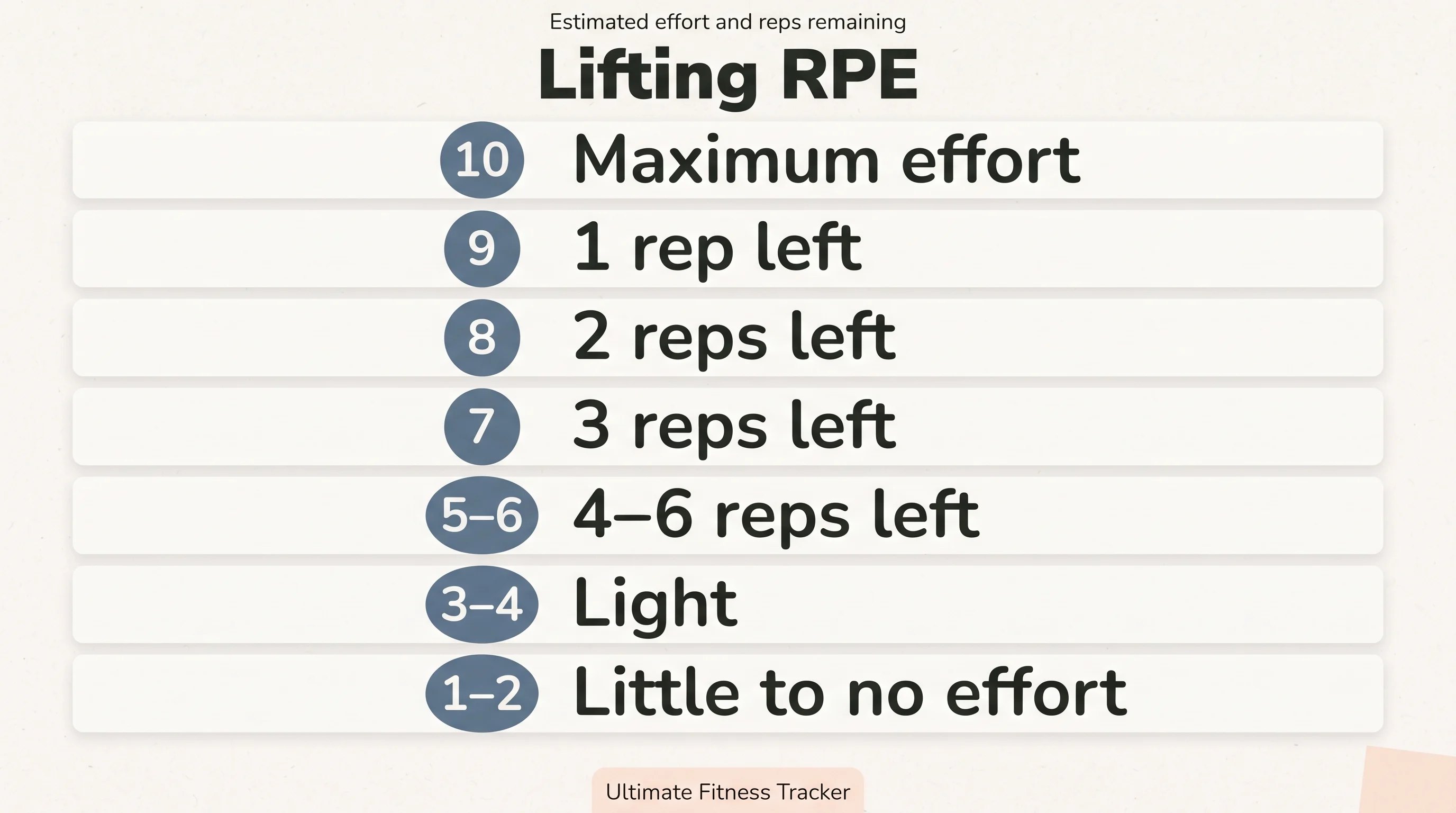
Repetitions in reserve (RIR) are the repetitions you estimate remain after a set. The lifting scale uses that estimate at its upper end, with broader effort descriptions below. Helms and colleagues' August 2016 paper presents the scale in Table 1. The descriptions below summarise it; they are definitions, not suggested training targets.
| Score | Meaning on the lifting scale | What to retain in your log |
|---|---|---|
| 10 | Maximum effort | Which set received this score |
| 9 | About one repetition remaining | The completed weight and reps |
| 8 | About two repetitions remaining | The completed weight and reps |
| 7 | About three repetitions remaining | The completed weight and reps |
| 5-6 | About four to six repetitions remaining | The score and any uncertainty |
| 3-4 | Light effort | The scale name |
| 1-2 | Little to no effort | The scale name |
Near the top, each whole point helps describe estimated reps left. Further down, the table uses ranges and effort words. Avoid extending a subtraction rule across the entire scale.
Write the scale name above the column or beside your notes. A heading such as "RPE, lifting, reps in reserve" carries more meaning than "Intensity" on its own.
Why the Scale Name Matters
RPE is used with several scales, so the same number can describe different things. Cleveland Clinic's explanation, updated 1 November 2023, covers the original Borg 6-20 scale and modified Borg CR10, which runs from 0 to 10.
Those are not interchangeable with the repetitions-in-reserve labels in the lifting table. A general effort description does not tell you how many more repetitions you estimate you could have completed.
New York Road Runners' undated RPE guide is another useful distinction: it describes running effort. Check the activity and definitions rather than assuming every 1-10 chart is a lifting chart. Both guides were checked on 13 October 2026.
Keep a running score in a running entry. Keep a lifting score beside a lifting set. If a programme names a particular scale, use its definitions and record that name. You do not need to convert between charts to maintain a readable log.
What Does RPE 7 Mean in a Lifting Log?
On the lifting scale above, RPE 7 records an estimate of about three repetitions remaining. The score describes the set you completed. It does not tell you to perform more repetitions to prove the estimate.
Consider an entry that says "squat, 8 reps, 60 kg, RPE 7." The first three fields describe completed work. The last field adds the lifter's estimate. These are illustrative numbers, not an example of what a reader should lift.
Someone else reading the row can see the work you completed and your estimate of effort. The row cannot verify your technique or show whether the estimate was correct.
What if I am unsure of the score?
Record the uncertainty beside the score. "Unsure between two ratings" is an observation you can retain. Do not silently choose the harder number or treat an early guess as a precise result.
For the next entry, keep the same scale and the same recording convention. If a qualified professional helps you interpret the log, uncertainty is useful context for that discussion.
An Example Log: Same Weight, Different Effort
A log can show a change in reported effort even when the completed weight stays the same. The following rows are constructed example data. They are not measured results, expected progress, or a training recommendation.
| Session | Exercise | Completed work | Last-set RPE |
|---|---|---|---|
| A | Squat | 3 sets of 8 at 60 kg | 8 |
| B | Squat | 3 sets of 8 at 60 kg | 7 |
| C | Squat | 3 sets of 8 at 60 kg | 9 |
Reading only the completed-work column gives three matching entries. Reading the last-set column shows three different effort reports. Neither column can replace the other.
The heading "Last-set RPE" matters here. It means the score refers to the last set of each exercise. It does not claim that all three sets received the same score. If you need every set's effort, record each set on its own row.
Check whether the exercise setup and recording method stayed the same. A rating entered at the time may read differently from one recalled later. The table needs those details if you want to compare its rows.
Treat a lower score as a lower reported effort for that entry. It is not proof of a lasting strength change. Keep the observation available and let the programme's own review process determine what it means.
Where to Put the Column
Put effort beside the completed work it describes, and define the scope of each rating. You can use paper or your own spreadsheet. The layout matters because you will need to understand the entry later.
Start with date, exercise, set number, completed reps, weight and scale name. Add RPE beside those fields. A separate notes field can hold uncertainty or a change in how you recorded the session.
If you prefer one row per exercise, label the effort field precisely. "Last-set RPE" and "Session RPE" describe different observations. Avoid an unexplained number that could mean either.
Record weight units too. A load entered in kg cannot be compared directly with a later number in lb. The effort score itself has no weight unit, so it will not reveal a units mistake.
Keep blank cells available. Missing data is easier to recognise when it stays missing. Filling a forgotten score from memory gives the row a certainty it did not have when the set ended.
What Makes Two Entries Comparable?
Two entries are easier to interpret when they use the same activity, scale and recording scope. First check those labels, then read the completed work and effort together.
If one entry describes a whole session and another describes its final set, keep that difference visible. If you change the scale, mark the date of the change. There is no need to overwrite older entries to make the column look uniform.
A practical reading order is exercise, reps, weight and units, rating scope, then score. This follows the record from completed work to personal estimate. The order prevents a number in the effort column from carrying more meaning than its row supports.
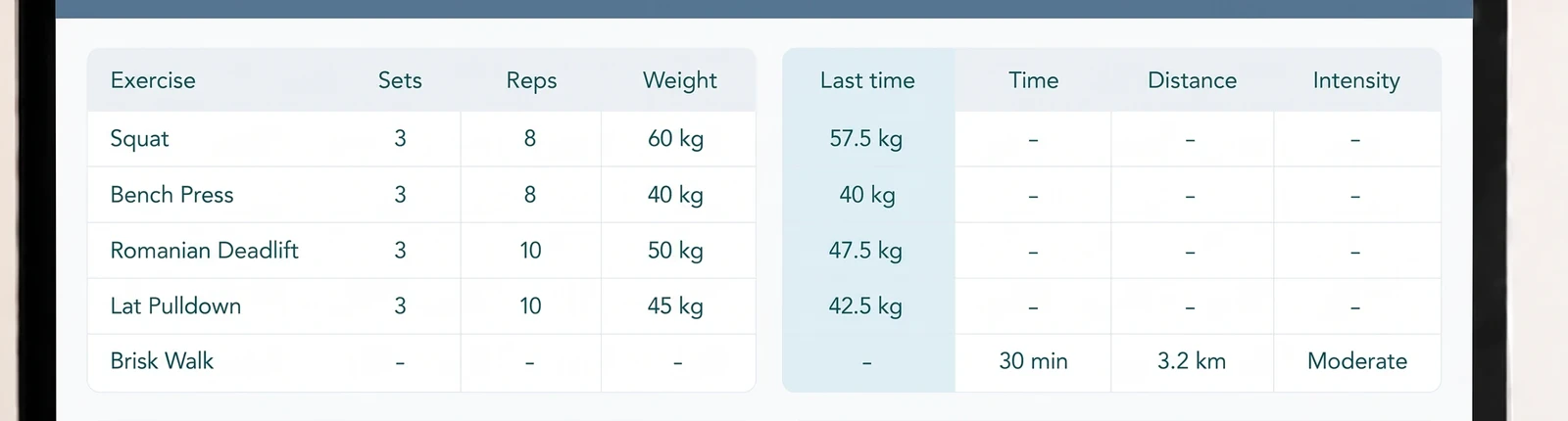
Keep any "last time" load beside the current load as a separate field. It helps identify the earlier work you are comparing. It does not establish that two effort estimates are accurate or comparable on its own.
Why Trust This Article
The Cosmo Suite team publishes this guide and sells a tracking spreadsheet. Scale definitions come from Cleveland Clinic and the resistance-training paper named above. The running guide illustrates why an activity label matters. Sources were checked on 13 October 2026. The table of sessions is constructed example data. We have no basis to claim clinical or coaching credentials.
Our about page identifies the publisher, and our editorial policy explains how we handle sources and corrections. Check the source definitions and discuss training decisions with a qualified professional. Use our contact page to report a correction.
Where the Ultimate Fitness Tracker Fits
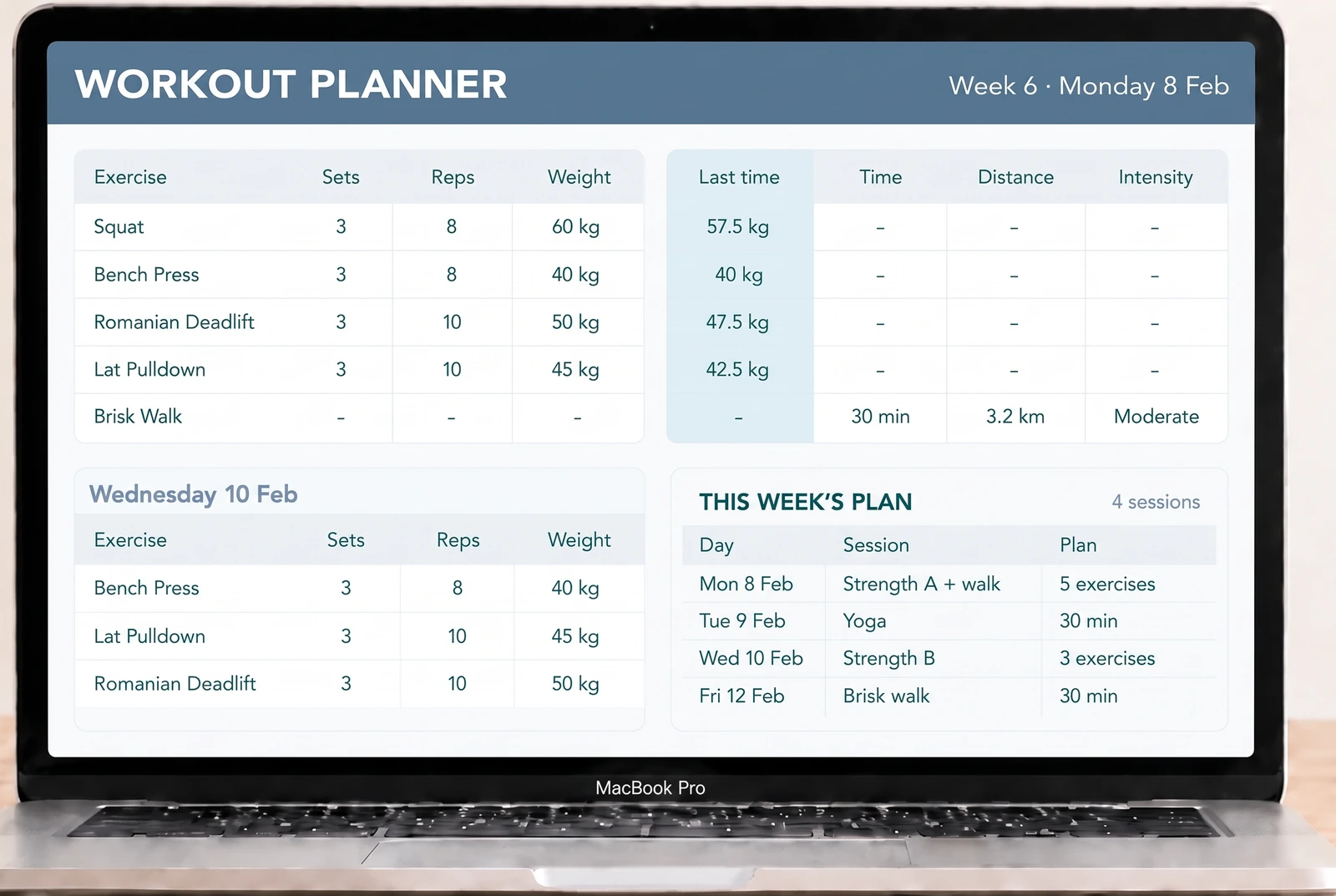
Ultimate Fitness Tracker, a weight loss and workout spreadsheet, has a Workout Planner with sets, reps, weight, intensity and what you lifted last time. You can keep a defined effort rating with those workout records. It is a file for recording your entries; it does not assess the rating or choose a load.
The spreadsheet for keeping workouts and last-time loads together includes Google Sheets and Excel versions. If you also keep other records, the guide to the weight loss tracker spreadsheet explains those fields. They remain separate from the meaning of a lifting RPE score.
Frequently asked questions
Does RPE 8 mean 80% of my maximum weight?
No. RPE describes perceived effort, while a percentage of maximum weight describes load. Two sets at the same weight can receive different effort scores. Keep weight and RPE in separate fields, and avoid turning an effort rating into a load percentage.
Can I use half points in my log?
Yes, if your programme defines them. Write that convention beside the scale name so later entries remain readable. Half points are optional. An uncertain rating should stay marked as uncertain rather than gain a decimal place that suggests precision you do not have.
Should I record an average across all my sets?
Only if you label it as an average. An average hides differences between sets. A row for each set preserves them. If you keep one exercise row instead, name the rating you record, such as last-set RPE, so you know what it represents later.
What should I enter when I forgot to rate a set?
Leave it blank or write not recorded. Zero can be a real rating on another scale, so it is a poor substitute for missing data. You can still retain the date, exercise, sets, reps and weight without inventing an effort score afterward.
Can I compare a running RPE with a lifting RPE?
Keep them separate. A running scale can describe overall effort; the lifting scale here describes estimated repetitions remaining. Matching numbers do not give them matching meanings. Name the activity and scale in each record before comparing sessions within that activity.
Will an effort column tell me what weight to lift next?
No. It records your estimate of effort alongside the work completed. It does not choose a training load or verify the estimate. Follow the programme agreed with a qualified professional, and use the log to retain observations rather than as an automatic instruction.